

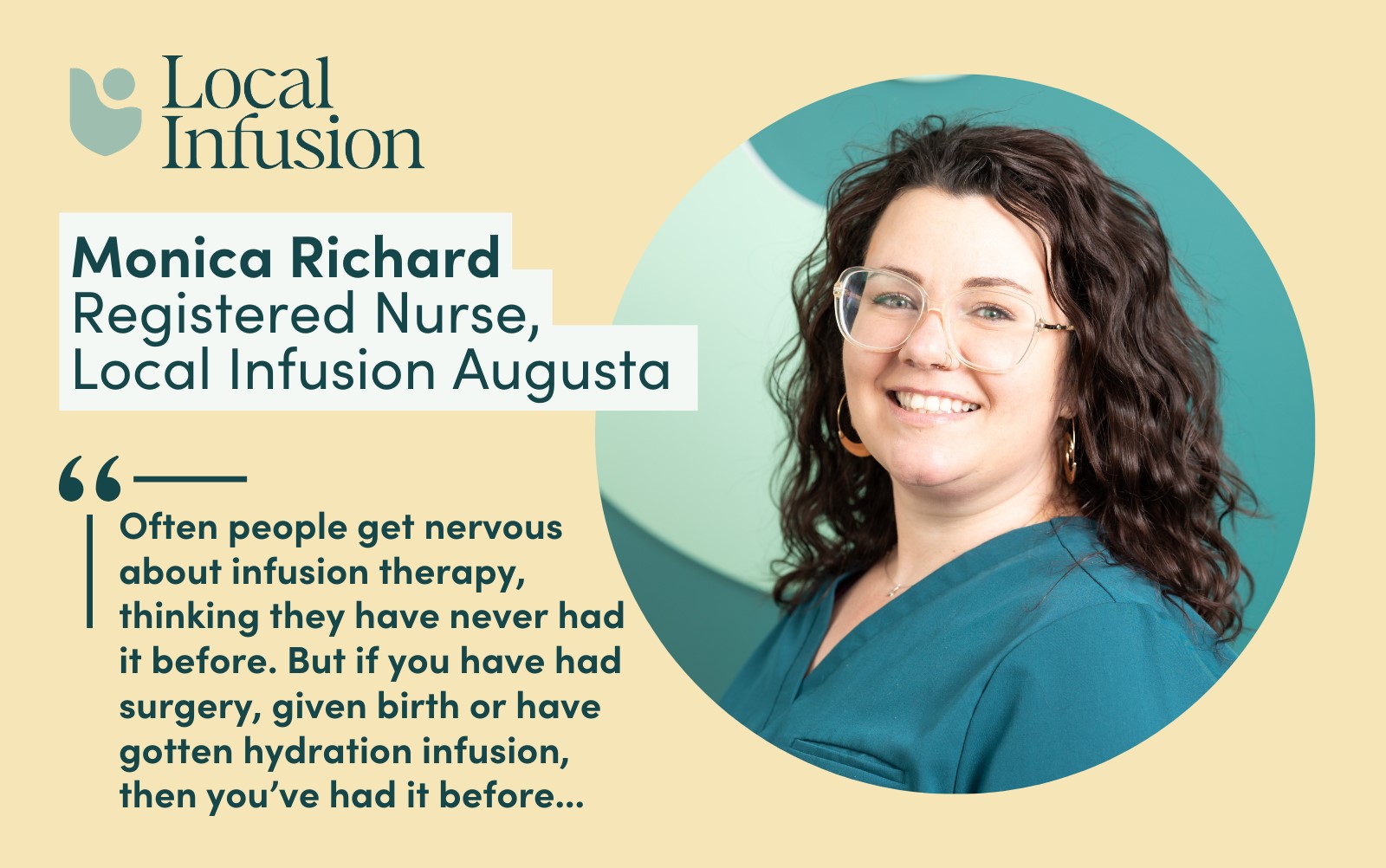
Since we opened our first infusion center earlier this year in Concord, New Hampshire, our care teams have noticed some common questions from first-time patients. Below, Monica Richard, RN at Local Infusion, shares answers.
Top 3 FAQs
We know that IVs can be a stressful part of the infusion process. Rest assured that our infusion nurses are RNs or NPs with years of experience and excellent IV skills (and tricks of the trade to help increase our success rate).
Prior to joining Local Infusion, I worked in busy ERs where almost every patient required an IV, and most were sick and considered “difficult sticks.”
Finally, know that you are in charge of your treatment at all times, so if you prefer a specific location for the IV, we will do our best to accommodate. And if you want us to stop at any time, we will.
An infusion is a procedure where medications or nutrients are delivered directly into the bloodstream. There are various methods and types of infusions, including intravenous (aka IV), intramuscular, and subcutaneous.
Intravenous: when a medication is delivered directly into a person’s vein. It’s understandable to feel nervous if your doctor says you need intravenous infusion therapy, but if you’ve ever had a surgery, given birth in a hospital, or had hydration at the hospital, you’ve had an intravenous infusion!
Intramuscular: when a medication is inserted into the muscle tissue (commonly the arm/deltoid muscle). If you’ve had a vaccination, then you’ve had an intramuscular infusion.
Subcutaneous: when a medication is injected into the fat under the skin (commonly the upper arms and stomach). If you know someone who takes insulin, those are subcutaneous infusions.
READ MORE: Infusion Therapy: What Is It & Conditions It Treats
We have a protocol in place for all types and severities of infusion reactions that may happen.
Some reactions are typical for the medication, so pausing the infusion and giving a medication like Benadryl will resolve the issue so we can continue the infusion after symptoms have eased. If, however, it is a more serious reaction to the medication, we are prepared with all the same medications and therapies that would be in an Emergency Department. And if the reaction is severe, we will call 911, as is the protocol for all outpatient infusion clinics.
When I worked in the ER, I had many patients — some of whom came from infusion clinics — have severe reactions to medications. So I am confident in our procedures at Local Infusion since they are the same as those I used in the past to treat patients.
The bottom line
Infusion therapy is life changing. But if it’s your first time, it can also be confusing — scary, even. And we understand that you will likely have questions about things like insurance and billing, scheduling, how to prepare for your treatment, and what to expect once you’re here. To facilitate communication and get your questions answered as quickly as possible, we pair every patient 1:1 with a dedicated Infusion Guide. This way, you can get the support you deserve not just before your first appointment, but every step of the way.
About Monica Richard, RN
Monica is a Registered Nurse at Local Infusion who comes from an emergency department background. She has over 5 years of medical experience with an advanced lifesaving certification as well as national certifications in trauma for both adults and pediatrics. Monica recently changed paths to become an infusion nurse in order to pursue a career that encompasses more of her personal patient care goals.
“I feel blessed to be part of the Local Infusion team, a team that goes above and beyond to not only treat the patient, but to provide an environment that nurtures and promotes health and healing for the mind, body, and soul.”
Have a question or need assistance?
We're happy to answer any of your questions.
Feel free to email us here and we’ll get back to you ASAP.